
Helping Enterprises Build a Traceable and Sustainable Data Foundation
As sustainability disclosure and rating frameworks continue to evolve—including those from the Hong Kong Stock Exchange, the Shanghai, Shenzhen, and Beijing stock exchanges, ISSB, GRI, CDP, and MSCI—corporate ESG and carbon management is shifting from annual report compilation toward day-to-day data governance.
For group-level enterprises, ESG and carbon emissions data is often scattered across different departments, subsidiaries, and business systems, relying on Excel spreadsheets, emails, and manual consolidation. This approach is not only inefficient but also prone to inconsistent data standards, untraceable version histories, unclear accountability, and incomplete audit chains.
Against this backdrop, what enterprises truly need is no longer just a report preparation tool, but a long-term ESG and carbon management data collection platform capable of unifying indicator systems, managing organizational structures, initiating data submission tasks, supporting multi-level review, accumulating historical data, and further serving report disclosure, rating improvement, peer benchmarking, and management decision-making.
The YoujiVest ESG & Carbon Management Data Collection Platform is an integrated data management system built for corporate ESG disclosure, carbon emissions management, and sustainable development governance. It covers the full workflow, including indicator configuration, template management, organizational permissions, task distribution, online data entry, audit trail tracking, report management, and data analytics.
The platform supports a unified indicator library, template-based configuration, group organizational structure management, task-driven data entry, multi-level review, data audit trails, report management, and multi-dimensional analytics. It helps enterprises reduce the cost of manual data collection, improve data quality and collaboration efficiency, and provides a reliable data foundation for ESG disclosure, carbon inventory, product carbon footprint, rating improvement, and management decision-making.
Capability 1: Unified Indicator Library
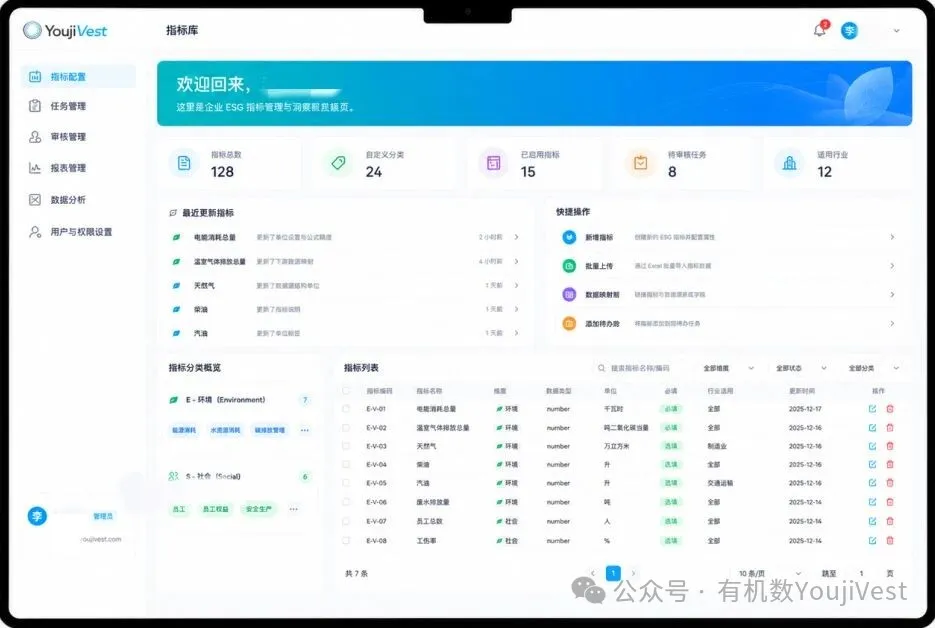
The platform enables enterprises to establish a unified ESG and carbon management indicator library covering different dimensions including environmental, social, governance, ESG, and carbon emissions. Enterprises can flexibly configure indicator templates for different scenarios such as annual reports, quarterly statements, regulatory disclosures, internal management, and carbon emissions accounting, achieving centralized maintenance, dynamic expansion, and version management of indicators.
Compared with traditional Excel spreadsheets, a unified indicator library helps enterprises avoid problems such as rebuilding tables from scratch every year, inconsistent standards across departments, and difficulty tracking historical versions. It ensures that ESG and carbon data has a structured, standardized, and reusable foundation from the very start.
Capability 2: Template-Based Configuration
The platform allows enterprises to create data collection templates based on different disclosure scenarios and management needs—for example, annual ESG report templates, quarterly carbon emissions data templates, supply chain data templates, and employee management templates. Each template can be linked to specific indicators, applicable reporting cycles, data timeframes, and dimensional scope, with support for version iteration and historical traceability.
Enterprises no longer need to design reporting forms from scratch each time. Instead, they can build a long-term, reusable, and continuously optimized indicator template system.
Capability 3: Org Structure & Portfolio Management
Designed for the multi-layered organizational structures of group enterprises, the platform supports unified management of company portfolios, parent-subsidiary relationships, departments, and employees. Different reporting tasks can be assigned to specific organizational nodes and responsible individuals, meeting the management requirements for tiered data entry, tiered review, and consolidated reporting across group headquarters, subsidiaries, and departments.
In the past, ESG and carbon data collection often relied on headquarters chasing individual departments for submissions. With the platform, the questions of who is responsible for data entry, who is responsible for review, and which organization owns the data are systematized, reducing communication costs and eliminating ambiguity around accountability.
Capability 4: Task-Driven Data Entry
The platform uses a task-flow approach to drive data collection. Administrators can create tasks based on reporting cycles, select corresponding indicator templates and participating companies, set start and end dates along with deadlines, and publish tasks to the relevant organizations and personnel with one click. Once published, the system automatically tracks task status—including assigning, in progress, under review, under inspection, completed, and overdue—helping managers monitor overall progress in real time.
Data collection is no longer a matter of sending Excel files, chasing emails, and manual consolidation. It becomes a configurable, trackable, and accountable online process.
Capability 5: Multi-Level Review & Audit Trails
ESG and carbon data must not only be collected but also withstand scrutiny. The platform supports task decomposition, indicator assignment, data entry review, return for revision, and approval workflows, helping enterprises establish a multi-level review mechanism from data submitters to reviewers, and from subsidiaries to headquarters. Every data entry, modification, return, and review action generates a process record, providing a basis for subsequent report disclosure, internal audits, and external assurance.
This elevates ESG and carbon management data from merely being collectible to being trustworthy, auditable, and verifiable.
Capability 6: Report Management & Analytics
The platform supports unified management of submitted and reviewed data, generating statistical views of pending items, returned items, approved items, and completion rates to help managers quickly identify submission progress and data quality status. Building on this, the system can automatically generate report drafts based on reviewed, traceable data rather than simply applying static templates. Every disclosed data point in a report can be linked back to its submission source, responsible person, review records, and supporting materials, structurally eliminating the repetitive work of manual cross-checking, table adjustments, and multi-party standard reconciliation that characterizes traditional report compilation.
Furthermore, the platform supports multi-dimensional trend analysis and topic-specific reports generated around company entities, indicator categories, and time ranges, with dedicated peer benchmarking and year-over-year comparison features. This functionality is designed to transform structured data into business gap analysis that management can intuitively understand, helping managers quickly identify their position within the industry, historical performance trends, and areas for improvement—truly achieving the leap from “data collection” to “management insight,” and providing actionable evidence for strategic decision-making and performance improvement.。
The value of the YoujiVest ESG & Carbon Management Data Collection Platform extends beyond helping enterprises complete a single round of data entry. Its greater purpose is to help enterprises accumulate a sustainable, reusable ESG and carbon management data foundation.
Through a unified indicator library, unified templates, unified task flows, unified review mechanisms, and unified data accumulation, the platform transforms ESG and carbon data that was previously scattered across different departments, subsidiaries, Excel spreadsheets, emails, and attachments into structured, traceable, analyzable, and reusable data assets.。
On this foundation, enterprises can achieve the following core management outcomes::
-
Efficient support for ESG report compilation: The platform centrally manages environmental, social, and governance-related indicators, case studies, supporting documents, and historical submission records, providing complete and traceable data sources for annual ESG reports, sustainability reports, and regulatory disclosures, significantly improving report compilation efficiency and information reliability.
-
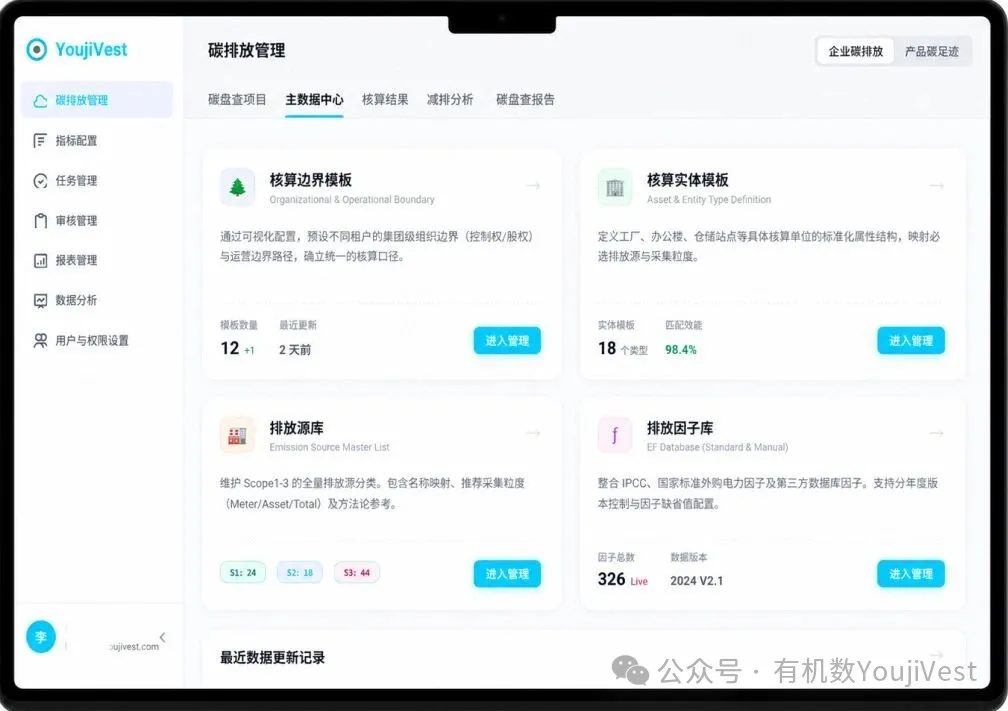
Systematic support for carbon inventory and emissions management:Through the continuous collection of carbon emissions-related indicators, activity data, energy consumption data, and supporting materials, enterprises can progressively build a carbon data management system covering organizational boundaries, emission scopes, emission sources, and accounting cycles, supporting carbon inventory compilation, inventory reports, and internal management analysis.
-
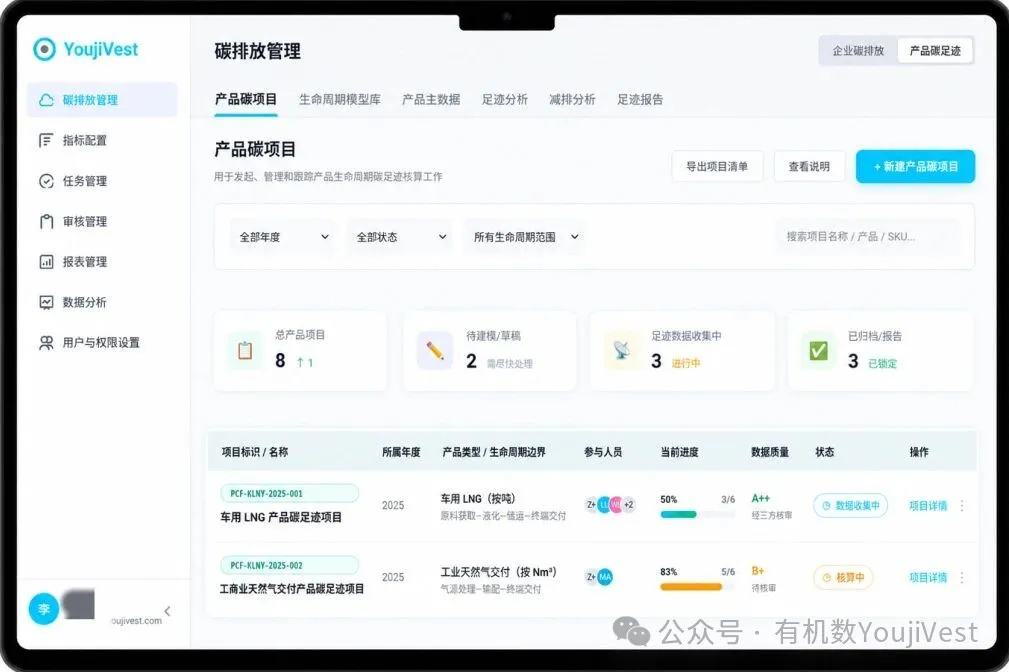
Deep support for product carbon footprint and Scope 3 management:Based on the unified data foundation, enterprises can continuously supplement activity data across product lifecycle stages, supply chain data, transportation data, and external emission factors, supporting product carbon footprint accounting, identification of high-emission stages, and ongoing tracking and management of key Scope 3 categories and key suppliers.
-
Continuous support for rating improvement and peer benchmarking:The platform supports mapping internal indicator systems to mainstream rating and disclosure frameworks such as MSCI, CDP, S&P, Wind, identifying key indicator gaps, disclosure shortfalls, and areas for management improvement. Through peer data benchmarking, it clearly presents enterprise strengths, gaps, and pathways for improvement, supporting management decision-making.
-
Building an integrated ESG and carbon management infrastructure: The platform transcends the traditional “form-filling tool” to become the core infrastructure for enterprise ESG and carbon management, serving report disclosure, carbon management, rating response, peer benchmarking, and management dashboard development. It drives enterprises forward from “decentralized collection and manual consolidation” toward a digital management stage of “unified governance, dynamic analysis, and continuous optimization.”
From data collection to management application, from report disclosure to low-carbon transition, YoujiVest is committed to helping enterprises achieve ESG and carbon management that is collectible, manageable, and actionable, and to crystallizing it into a long-term organizational capability that is traceable, analyzable, reusable, and continuously evolving.